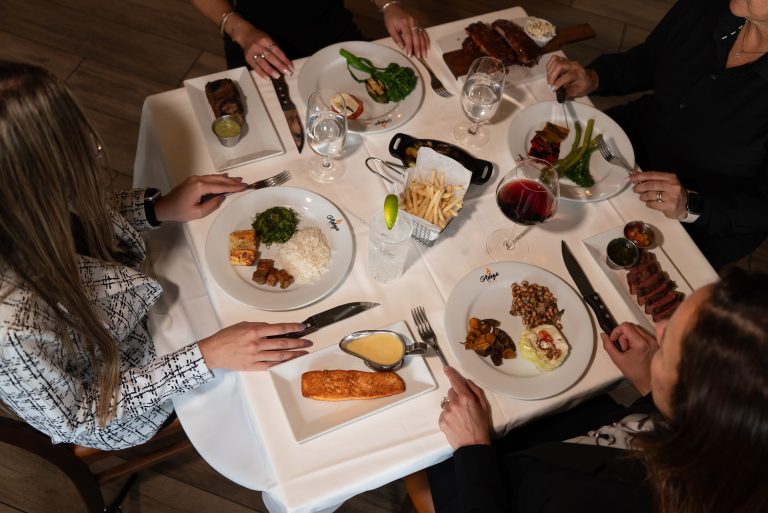


No, a Brazilian steakhouse is not halal by default. Most churrascarias serve pork in the same rodizio rotation as the beef, cook many cuts over one shared fire, and use non-halal ingredients in some sides and drinks. Some, including Adega Gaucha, offer select halal cuts on request, prepared separately from the rest.
Because halal availability varies by restaurant and even by location, the only reliable answer comes from the specific restaurant you plan to visit.
It usually starts in a group chat. Someone suggests a Brazilian steakhouse for a birthday, and someone else asks the question everyone was thinking: “Is it halal?” A quick search turns up a Yelp question from years ago, a directory listing, a couple of social videos filmed at a location in another state, and no clear answer.
So, are Brazilian steakhouses halal? This guide gives you the clear answer. We’ll explain why rodizio service isn’t halal by default, walk through a real churrasco rotation skewer by skewer, show you how to judge what you find online about any chain, and explain exactly how Halal works at our own restaurants.
Key Takeaways
- A Brazilian steakhouse is a style of restaurant, not a halal category. Each one sets its own policy.
- In a standard rodizio, pork and bacon-wrapped cuts travel the same dining room as the beef.
- “Halal options” usually means select halal cuts on request, not a fully halal restaurant.
- Online answers about big chains are often old, secondhand, or about a different location.
- Always confirm with the exact location, then remind your server when you sit down.
Are Brazilian Steakhouses Halal? Why the Answer Is “Not by Default”
A Brazilian steakhouse, or churrascaria, is built around churrasco: meat roasted on long skewers over open flame. In rodizio service, gauchos carry those skewers from table to table and carve slices onto your plate until you flip your card from green to red. Pork has always been part of that tradition: Wikipedia’s overview of the churrascaria lists it among the classic meats carried on the skewers.
That format is exactly what makes halal tricky. Three things work against a default halal experience:
- Pork is part of the tradition. Pork sausage, pork ribs, and bacon-wrapped cuts are classic rodizio items, not add-ons.
- One fire, many skewers. In most kitchens, different meats roast side by side in the same churrasqueira.
- Service is automatic. Gauchos bring the full rotation to every green card. Unless your table makes a request, nobody separates anything for you.
None of this means a Muslim diner can’t enjoy a churrascaria. It means halal has to be requested, prepared separately, and confirmed. You can’t assume it.
A Skewer-by-Skewer Look at a Real Rodizio Rotation
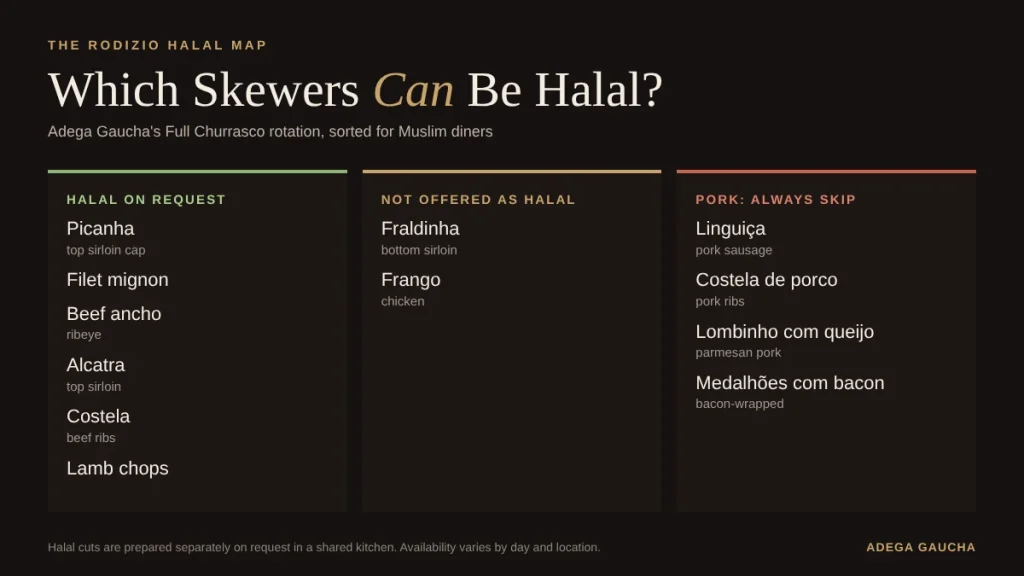
Talking in generalities only gets you so far, so here’s our own Full Churrasco Experience rotation, item by item, with what each one means for a halal diner. Other steakhouses will differ, and our selection can vary by location and day.
| Rotation item | What it is | Halal at Adega Gaucha? |
| Picanha | Top sirloin cap, our signature cut | Halal version on request |
| Filet mignon | Beef tenderloin | Halal version on request |
| Beef ancho | Ribeye | Halal version on request |
| Alcatra | Top sirloin | Halal version on request |
| Costela | Slow-roasted beef ribs | Halal version on request |
| Cordeiro | Lamb | Halal lamb chops on request |
| Fraldinha | Bottom sirloin (bavette) | Not offered as Halal |
| Frango | Chicken | Not offered as Halal |
| Medalhões com bacon | Bacon-wrapped chicken and steak | No: wrapped in pork |
| Linguiça | Pork sausage | No: pork |
| Costela de porco | Pork ribs | No: pork |
| Lombinho com queijo | Parmesan-crusted pork | No: pork |
Two things stand out. First, half of our rotation isn’t offered as Halal at all, and four of those items are pork or wrapped in pork, so it helps to know the names before the gauchos arrive.
Our guide to linguiça explains why that first sausage skewer is one to pass on. Second, the beef and lamb in a regular rotation aren’t automatically the halal versions. The Halal cuts are prepared separately, on request.
Beyond the Skewers: Sides, Salad Bar, Desserts and Drinks
The meat gets the attention, but the rest of the meal deserves a look too. At most churrascarias, watch for:
- Cured meats and bacon at the salad bar. Charcuterie boards and bacon-topped salads are common. Our own Gourmet Table includes charcuterie and endive with candied bacon, for example.
- Traditional sides. Classic Brazilian farofa is often toasted with bacon, and feijoada is a black bean stew traditionally made with pork.
- Grill-side extras. Grilled pineapple and grilled cheese often cook on the same fire as everything else.
- Desserts that may contain gelatin or liqueur.
- Drinks. The caipirinha, Brazil’s national cocktail, is made with cachaça, a sugarcane spirit. Most steakhouses also have alcohol-free drinks.
Many dishes are naturally suitable, from salads and vegetables to rice and beans and warm pão de queijo. The safest move is to ask your server to walk you through the gourmet table before you fill a plate.
“Halal Options” vs. “Halal Restaurant”: Read the Wording Carefully
When a steakhouse says it’s halal-friendly, it almost always means one of these:
- Fully halal: everything on the menu is halal, and there’s no pork or alcohol. This is rare for a Brazilian steakhouse.
- Halal-certified: a third-party certifier has approved the restaurant itself, not just its supplier.
- Halal options or halal on request: select cuts are halal and prepared separately in a kitchen that also cooks non-halal food. This is the most common model, and it’s how Adega Gaucha works.
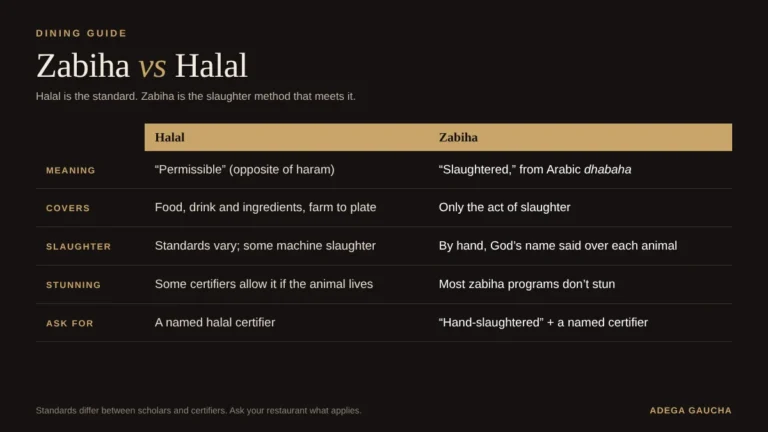
Each model suits different diners. Some guests are comfortable with halal-sourced cuts prepared separately in a shared kitchen; others only eat at fully halal restaurants. If certification or hand slaughter matters to you, our guide to zabiha vs halal explains the difference and includes a checklist of questions to ask before you book.
Are Other Brazilian Steakhouse Chains Halal?
These are among the most searched halal questions about Brazilian steakhouses, so here’s our honest answer: we can’t speak for other restaurants, and you shouldn’t rely on secondhand answers either. Halal policies can differ from one chain to another, between locations of the same chain, and over time as suppliers change.
Look at what currently shows up in searches. You’ll see the same questions diners post on review sites again and again:
“Is your meat halal?”
A question posted on a review site’s Q&A section
“Do you cook halal food separate?”
A question posted on a travel review site
Those questions are exactly right. The problem is the answers. Here’s how to weigh what you find:
- Review-site Q&A: answers are often from other diners, not the restaurant, and may be years old.
- Halal directories: listings are useful leads, but they’re often user-submitted and may not reflect today’s menu.
- Social videos: they show one location on one day. A different city’s location may work differently.
- The restaurant’s own current website or FAQ: a better source, especially if it names specific cuts and explains how they’re prepared.
- A call to the exact location you’ll visit: the most reliable source of all, because it reflects what that kitchen does now.
The same rule applies to us. Everything on this page reflects our current policy, and our team will confirm the details for your specific visit.
4 Questions That Only Matter at a Rodizio
Beyond the general halal questions, the rodizio format raises a few of its own. Ask these when you book:
- “How are Halal cuts served: on their own skewers at the table, or plated?” This tells you how separation works during service, not just in the kitchen.
- “How will the gauchos know which cuts to offer our table?” A good restaurant has a system so your table isn’t offered pork by mistake.
- “Which rotation items should we skip?” Get the names of the pork and bacon-wrapped skewers in advance.
- “Can you guide us through the gourmet table?” One quick walkthrough saves a lot of guesswork.
How Halal Works at Adega Gaucha
Here’s exactly where we stand, so you can decide before you book:
- Six cuts can be prepared as Halal on request: picanha, lamb chops, beef ribs, filet mignon, alcatra, and beef ancho. Availability can vary by day and location.
- Sourcing: these cuts are sourced as Halal from our suppliers.
- Preparation: Halal cuts are prepared to order with separate utensils and designated grill space.
- Kitchen: ours is a shared kitchen, and our menu includes pork and other items that aren’t Halal.
- Certification: Adega Gaucha isn’t a Halal-certified restaurant, and the Full Churrasco Experience as a whole isn’t Halal.
What a Halal Night at Adega Gaucha Looks Like
- When you book, mention Halal cuts in your reservation or by phone so the kitchen can prepare.
- When you sit down, remind your server so the dedicated utensils and grill protocol are followed.
- At the Gourmet Table, ask your server which salads, sides, and desserts suit your preferences.
- Then relax and enjoy the churrasco, carved with dedicated care.
Halal cuts are available on request at our Orlando, Kissimmee, and Deerfield Beach restaurants, and our Dunwoody, GA location opens in January 2027. Planning a birthday, Eid dinner, or company event? We can arrange personalized Halal menus for groups with advance notice. For the complete cut-by-cut details and FAQs, visit our Halal dining page.
Frequently Asked Questions
Are Brazilian steakhouses halal?
Not by default. Most Brazilian steakhouses serve pork in their rodizio rotation and cook many meats over a shared fire. Some offer select halal cuts on request, prepared separately. Policies vary by restaurant and location, so confirm directly before you book.
Is Brazilian churrasco halal?
Churrasco is a cooking style, so it can be halal or not. It depends on the meat’s source and slaughter, and on whether the restaurant keeps halal cuts separate from pork and other non-halal items during prep, grilling, and serving.
Is meat from Brazil halal?
Not automatically. Brazil exports a lot of halal-certified meat, but where meat comes from doesn’t make it halal. What matters is how the animal was slaughtered and certified, and how the restaurant handles it.
Is picanha halal?
Picanha is a beef cut, the top sirloin cap, so it can be halal if the beef is halal and prepared separately. At Adega Gaucha, a Halal version of picanha is available on request, subject to availability.
Are other Brazilian steakhouse chains halal?
We can’t speak for other restaurants. Halal policies can vary between chains, between locations, and over time. Check the restaurant’s own current website and call the specific location you plan to visit for an up-to-date answer.
Is Adega Gaucha halal?
Adega Gaucha isn’t a fully Halal-certified restaurant. We offer six Halal cuts on request: picanha, lamb chops, beef ribs, filet mignon, alcatra, and beef ancho. They’re prepared with separate utensils and designated grill space in a shared kitchen.
Do I need to request Halal in advance?
You can ask when you arrive, but requesting Halal cuts when you book gives the kitchen time to prepare and helps make sure your preferred cuts are available.
Enjoy the Churrasco, Your Way
A Brazilian steakhouse can absolutely be part of your celebration. Just don’t assume halal. Know which skewers to skip, read online answers with a healthy dose of skepticism, and get a clear, current answer from the restaurant itself. If you’d like that answer from us, we’re happy to give it.