

Halal is the broad Islamic standard for what is permissible to eat. Zabiha (also written dhabiha or zabihah) is the method of slaughter that makes meat halal: a Muslim slaughters a healthy, living animal by hand, says God’s name, and makes one swift cut across the throat so the blood drains out.
Zabiha done correctly is always halal. In the U.S., though, not everything labeled “halal” is hand-slaughtered zabiha, and that gap is why so many diners ask about both.
Maybe you’ve stood at a host stand trying to work out how to ask “Is this halal?” without making it awkward. Or you’ve seen “halal” on a menu and wondered whether it means the same thing it means at your local butcher. This zabiha vs halal guide is for that moment.
We’ll explain both terms in plain language, show where scholars and certifiers disagree, walk through what changes when you eat at a Brazilian steakhouse, and give you the exact questions to ask before you book. We’ll also be upfront about how Halal works at our own restaurants. A guide like this is only useful if the restaurant writing it is honest about itself.
Key Takeaways
- Halal means permissible. Zabiha is the slaughter method that makes meat halal.
- Properly performed zabiha is always halal, but a “halal” label in the U.S. doesn’t guarantee hand slaughter.
- Three questions cause most of the confusion: stunning, machine slaughter, and meat from Christians and Jews (the People of the Book).
- At a restaurant, how the kitchen handles the meat matters as much as where it came from.
- Before you book, ask about the cut, the supplier, the certifier, and the grill.
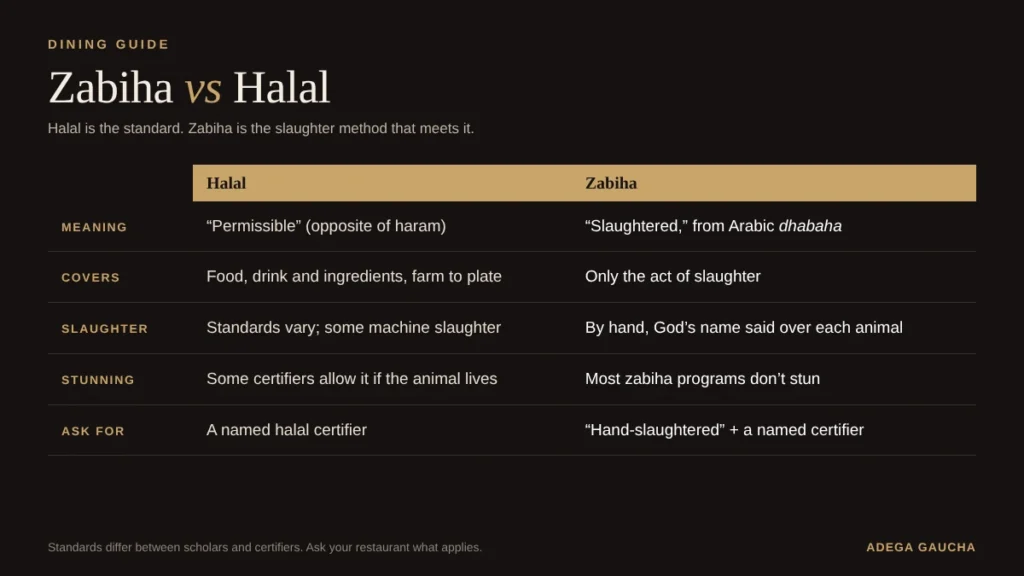
Zabiha vs Halal at a Glance
| Halal | Zabiha | |
| What the word means | “Permissible” in Arabic; the opposite of haram | “Slaughtered,” from the Arabic root dhabaha |
| What it covers | Food, drink, ingredients and conduct. For meat, the whole journey from animal to plate | Only the act of slaughtering the animal |
| Who slaughters | Depends on the standard. Some accept slaughter by Christians or Jews | A Muslim. In North America the word usually also means “by hand” |
| Stunning | Some certifiers allow it if the animal is still alive at the cut | Most zabiha-labeled programs don’t stun |
| Saying God’s name | Required | Said over each animal at the moment of slaughter |
| Chicken | Some halal chicken is machine-slaughtered | Hand-slaughtered |
| What to look for | A named halal certifier | “Hand-slaughtered” or “zabiha” plus a named certifier |
What Does “Halal” Actually Mean?
Halal is an Arabic word meaning permissible or lawful. Its opposite is haram, meaning forbidden. The idea reaches well beyond food, but when people search for “halal meat,” three things have to line up:
- The animal. It must be a permissible species. Cattle, sheep, goats, and chicken qualify; pork never does.
- The slaughter. The animal must be slaughtered the Islamic way (this is where zabiha comes in).
- Everything after. The meat must stay clear of haram ingredients such as pork, blood, and alcohol, from the processing plant to the plate.
The Qur’an sets out the core prohibitions in Surah Al-Ma’idah, verse 3: meat from animals that died on their own, blood, pork, animals dedicated to anything other than God, and animals killed by strangling, a blow, or a fall.
That third point catches people out. A steak can come from a properly slaughtered animal and still not be something you’re comfortable eating if it’s marinated in wine or carved with the same knife as a pork sausage. We go deeper on the beef side in our guide to what makes beef halal, from farm to table.
What Does “Zabiha” Mean?
Zabiha (ذبيحة) comes from dhabaha, the Arabic verb “to slaughter.” You’ll also see it spelled dhabiha, zabihah, or zabeeha. All of them refer to the same thing: the Islamic method of slaughtering an animal for food. It has five parts.
- The person. A sane adult Muslim performs the slaughter. Many scholars also accept a Christian or Jew, which we cover below.
- The animal. It must be alive and healthy at the moment of slaughter.
- The words. The slaughterer says Bismillah, Allahu Akbar (“In the name of God, God is the Greatest”). The Qur’an (6:121) tells believers not to eat meat over which God’s name hasn’t been mentioned.
- The cut. One swift stroke with a very sharp blade across the throat, cutting the windpipe, the food pipe, and the major blood vessels of the neck, without cutting off the head.
- The drain. The blood is allowed to flow out fully, since blood itself is forbidden to eat.
Islamic tradition also stresses mercy: sharpen the blade out of the animal’s sight, don’t slaughter one animal in front of another, and keep the animal calm.
In everyday American use, “zabiha” has picked up an extra layer of meaning. When a butcher or restaurant says zabiha, they usually mean hand-slaughtered by a Muslim, with God’s name said over each animal, and no stunning. That’s stricter than what some halal labels require, and it’s the source of most of the “zabiha vs halal” confusion.
Is All Halal Meat Zabiha?
Here’s the short version. Every animal slaughtered correctly by the zabiha method is halal. But not every product sold as “halal” in the U.S. meets the hand-slaughter standard many people mean when they say zabiha. Three issues explain the gap.
1. Stunning
Many large processing plants stun cattle and poultry, so the animal is unconscious before the cut. Scholars and certifiers agree that if stunning kills the animal before slaughter, the meat isn’t halal. They disagree about stunning that leaves the animal alive. Some certifiers accept it; others reject any stunning at all.
2. Machine Slaughter
This mostly affects chicken. In high-volume plants, a rotating blade does the cutting while a Muslim worker says God’s name over the line. Some certifiers accept this. Many scholars don’t, because God’s name isn’t said by the person making each individual cut. If you buy “halal chicken” and want hand slaughter, check the label for it specifically.
3. Meat From the People of the Book
The Qur’an (5:5) says the food of those given earlier scripture, meaning Jews and Christians, is lawful for Muslims. Some scholars read this to allow conventionally slaughtered or kosher meat. Others say the meat still has to be slaughtered the Islamic way, with God’s name. That’s why some Muslims eat kosher meat comfortably and others won’t.
None of this is our call to make. These are questions of personal practice, and respected scholars come to different conclusions. If you’re unsure where you stand, your local imam is the right person to ask. Our job as a restaurant is to give you accurate information so you can apply your own standard.
Why the Word on the Menu Isn’t the Whole Story
Even when the meat itself is halal, there are three points where that status can break down.
- The source: who slaughtered the animal, how, and which organization certified it.
- The supply chain: how it was cut, packed, stored, and shipped.
- The kitchen: which knives, boards, grills, and marinades touch it before it reaches you.
A certified supplier doesn’t make a restaurant certified. That’s why restaurants tend to fall into three groups: fully halal, halal-certified, and restaurants that offer halal options inside a kitchen that also cooks non-halal food. None of these labels is “good” or “bad.”
What matters is whether the restaurant tells you clearly which one it is. We break this down further in our article on halal-friendly vs fully halal restaurants in South Florida.
Zabiha and Halal at a Brazilian Steakhouse: What’s Different
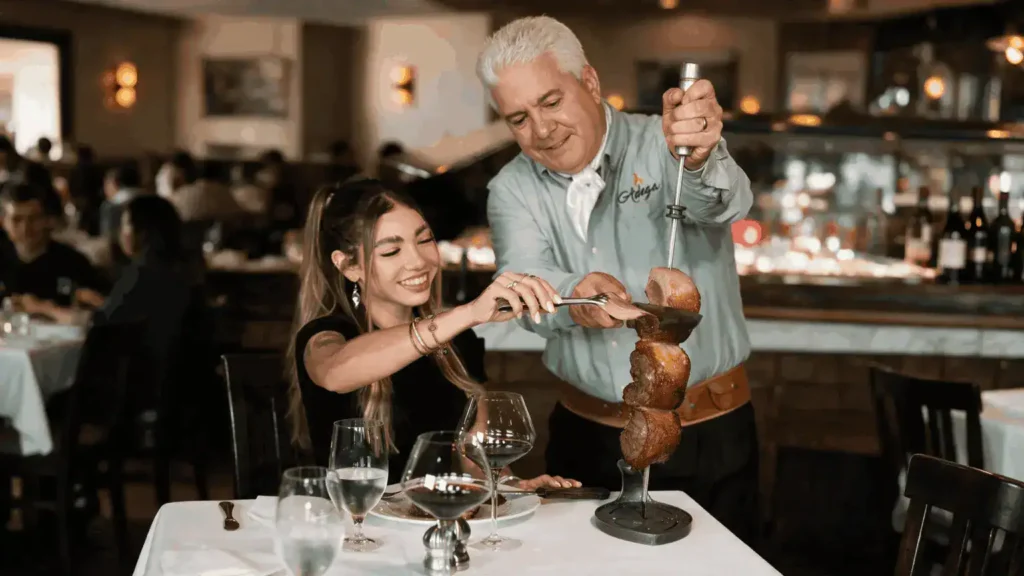
A Brazilian steakhouse works differently from a regular restaurant, so the halal questions are different too. In a traditional churrasco service, gauchos carry long skewers to your table and carve the meat in front of you, and many cuts cook over the same open fire. Here’s what to keep in mind.
- Skewers, knives and fire. Ask whether Halal meat gets its own skewers, carving knives, and grill space, or shares them with other cuts.
- Pork on the floor. Most churrascarias serve pork. Linguiça, the garlicky sausage that often arrives first, is traditionally pork. Bacon-wrapped cuts are common, and classic feijoada is made with pork.
- Marinades and sauces. Some recipes use beer, wine, or cachaça. Ask before you assume.
- The salad bar or gourmet table. Look out for gelatin in desserts, bacon in salads, cured meats, and alcohol in dressings.
- The default service. In an all-you-can-eat rodizio, the standard cuts come to every table automatically. Halal usually has to be requested so it can be prepared and served separately.
7 Questions to Ask Before You Book a Steakhouse
Save this list, or copy it straight into your reservation notes. A good restaurant should be able to answer every question, even if the honest answer is “we don’t know.”
- “Which cuts are Halal on the day I’m visiting?” Availability often depends on supply, so ask for your specific date.
- “Who supplies your Halal meat, and who certifies it?” A named certifier is something you can look up yourself.
- “Is it hand-slaughtered (zabiha), and is it stunned?” If this is your standard, ask directly. Don’t assume “halal” covers it.
- “Is your kitchen fully Halal, or shared?” Most steakhouses are shared. The real question is how they keep things separate.
- “Do Halal cuts get separate skewers, knives, and grill space?” At a Brazilian steakhouse, this matters more than almost anything else.
- “Are any marinades, sauces or sides made with alcohol, pork or gelatin?” This covers the gourmet table as well as the meat.
- “How much notice do you need, and can you do Halal for a group?” Birthdays, Eid dinners and company events need more planning.
One practical tip: ask when you book, then tell your server again when you sit down. If a restaurant answers every question with a quick “yes, it’s all halal” and no details, that’s less reassuring than one that tells you exactly what it does and doesn’t do.
How Halal Works at Adega Gaucha: Our Straight Answers
We’d rather you have these answers before you arrive than find out at the table. Here’s exactly where we stand.
- Six cuts are available as Halal on request: picanha, lamb chops, beef ribs, filet mignon, alcatra, and beef ancho (ribeye). Availability can vary by day and location.
- Sourcing: these cuts are sourced as Halal from our suppliers.
- Certification: Adega Gaucha isn’t a Halal-certified restaurant, and we don’t hold third-party zabiha certification. That’s why we don’t describe our cuts as zabiha.
- Kitchen: Ours is a shared kitchen, and our full menu includes items that aren’t Halal.
- Protocol: Halal cuts are prepared to order with separate utensils and designated grill space to prevent cross-contact.
- The Full Churrasco Experience: the experience as a whole isn’t Halal. Halal cuts are prepared on request rather than served by default.
If hand slaughter or a specific certifier is part of your standard, contact your location before you book and ask about the supplier for your visit. If we can’t confirm something, we’ll tell you.
How to Request Halal
- Mention Halal cuts when you book through our reservations page or by phone.
- Remind your server when you’re seated so the dedicated utensils and grill protocol are followed.
- Ask your server which gourmet table sides, salads, and desserts suit your preferences.
Planning a family celebration, an Eid dinner, or a corporate event? We can put together personalized Halal menus for groups with advance notice. Halal cuts are available on request at our Orlando, Kissimmee, and Deerfield Beach restaurants, and our Dunwoody, GA location opens in January 2027. If you’re visiting Central Florida, here’s our guide to Halal options in Orlando and Kissimmee. For the full cut-by-cut breakdown, see Halal dining at Adega Gaucha.
Frequently Asked Questions About Zabiha and Halal
Is zabiha the same as halal?
Not exactly. Halal is the overall standard for what Muslims may eat. Zabiha is the slaughter method that makes meat halal. Correctly performed zabiha is always halal, but in the U.S. some products labeled halal are machine-slaughtered or stunned, so they may not meet the hand-slaughter standard many people mean by zabiha.
Does zabiha meat taste different?
Some people say fully bled, hand-slaughtered meat tastes cleaner. In practice, flavor depends much more on the breed, the animal’s feed, aging, and how the meat is cooked. People choose zabiha for religious reasons rather than for taste.
Is stunned meat halal?
If stunning kills the animal before the cut, the meat isn’t halal. Scholars and certifiers disagree about stunning that leaves the animal alive. Some accept it; others require no stunning at all. Check the certifier’s standard, or ask your local imam.
Is machine-slaughtered chicken halal?
Opinions differ. Some certifiers accept machine slaughter when a Muslim operator says God’s name over the line. Many scholars require each bird to be slaughtered by hand. If hand slaughter matters to you, look for it on the label.
Is kosher meat zabiha?
No. Kosher slaughter (shechita) is a Jewish practice with its own rules, and it doesn’t include the Islamic invocation. Some Muslims eat kosher meat under the People of the Book allowance; many who keep a zabiha standard don’t.
Is Adega Gaucha’s Halal meat zabiha?
We don’t describe our cuts as zabiha, and we don’t hold third-party zabiha certification. Our six Halal cuts are sourced as Halal from our suppliers and prepared on request with separate utensils and designated grill space in a shared kitchen. If hand slaughter is your standard, contact your location before booking and ask about the supplier for your visit.
Can I request Halal cuts for a large group?
Yes. We can arrange personalized Halal menus for groups, celebrations and private events. Contact your location in advance so the team can confirm availability and plan preparation.
Eat With Confidence, Whatever Your Standard
Zabiha and halal aren’t competing ideas. One is the method, the other is the standard. Where people differ is on stunning, machine slaughter, and who may slaughter, and those are personal decisions made with your own scholars.
The rest is up to restaurants: give clear answers, keep Halal handling separate, and never claim more than we can back up. That’s the standard we hold ourselves to.